SAS, SARL, SASU, EURL, EI, SA: behind these French abbreviations are different rules on the number of partners, capital and liability. When you check a French company, its legal form tells you what kind of structure you're dealing with, and it appears in the official data as a code. This guide covers the most common forms, their basic rules, and how to read a company's form in the register data.
The rules below come from service-public, the French administration's official information site (page "Choosing the legal form", checked on 10 April 2026), read on 8 October 2026.
What you'll learn
- The most common French legal forms and their basic rules
- The difference between a sole trader and a company
- What the form says about the partners' liability
- How the form appears in the data (INSEE code, ELF code)
- Why the form matters when you check a company
The common forms, in one table
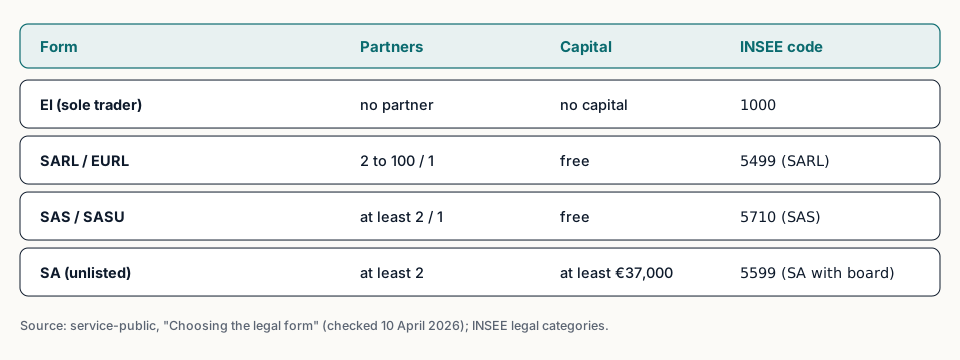
The sole trader (EI, entrepreneur individuel) isn't a company: it's the entrepreneur, a natural person, who trades. There are no partners and no share capital. According to service-public, the entrepreneur has a business estate automatically separated from their personal estate, with exceptions for fraud or serious breaches. A micro-entrepreneur is a sole trader under a simplified scheme.
The SARL (société à responsabilité limitée, a private limited company) has between 2 and 100 partners and free capital. Its single-partner version is the EURL.
The SAS (société par actions simplifiée, a simplified joint-stock company) has at least 2 partners and free capital. Its single-partner version is the SASU. Its articles have wide freedom to organise how it's run.
The SA (société anonyme, a public limited company) has at least 2 partners if it isn't listed, 7 if it is, and capital of at least €37,000.
Other forms exist, including general partnerships, limited partnerships, professional practice companies and the European company, but these cover most of what you'll meet.
What the form says about liability
This is often the question that matters for a supplier or a customer. According to service-public:
- In an SAS, an SARL or an SA, the partners' liability is limited to what they contributed to the capital. The manager can still be personally liable for mismanagement or if they gave a personal guarantee.
- In a general partnership (SNC), or for the general partner of a limited partnership, the partner is jointly and indefinitely liable for the company's debts.
- For a sole trader, the business estate is separate from the personal estate, with exceptions.
The form says nothing about how sound a company is, though: an SA isn't more reliable than an SAS because its minimum capital is higher.
Liability also explains why some customers ask for a personal guarantee from the manager of a small company, or why a supplier may ask a sole trader for different payment terms. Those are commercial choices, not legal requirements; the register only tells you which form applies, and the rest is a conversation between the two parties. If the form matters for a contract, check it before signing rather than after: a short lookup is cheaper than renegotiating a deal signed with the wrong entity.
How the form appears in the data
In the Sirene directory, every French company carries a legal category (catégorie juridique), a four-digit code kept by INSEE. Some codes you'll see often, taken from real companies:
- 1000: sole trader (entrepreneur individuel);
- 5499: SARL (with no further detail);
- 5710: SAS, for example Doctolib;
- 5599: SA with a board of directors, for example Danone;
- 5510: national SA with a board of directors, for example Renault;
- 5308: partnership limited by shares, for example Michelin;
- 5800: European company (SE), for example Decathlon.
These codes are precise but specific to France. To compare forms across countries there's the international standard ISO 20275 and its list of ELF codes (Entity Legal Forms): the SAS is 6CHY there, the SA with a board of directors K65D. A German GmbH or a Spanish S.L. has its own ELF code in the same list, which is what makes cross-country comparisons possible.
Fuentio gives both in every French record: INSEE's original code and label, and the matching ELF code, with a broad category. For the other data in a French record, read the French company registers explained.
Why the form matters when you check a company
- Consistency with documents. A contract signed "on behalf of X SAS" when the register shows an SARL deserves a question: a drafting error, or a different entity?
- Who can sign. The manager's title depends on the form: président in an SAS, gérant in an SARL. Compare the role you're told with the role the register shows.
- Sole trader or company. With a sole trader, you contract with a natural person: their personal data falls under data protection law, and the register can restrict what it publishes about them.
- Groups. Large groups often combine forms: an SA or SE at the top, SASs for subsidiaries. Make sure the entity on the contract is the one you checked, not its parent or a sister company.
For more on checking a company, read what KYB is; for checking whether it's still active, read how to check whether a French company is still active. See what we cover in France and Spain.
Limits. This guide summarises the basic rules published by service-public, read on 8 October 2026; it doesn't replace a company's articles or advice on choosing a form. The legal form says nothing about a company's finances. Not legal advice.
Frequently asked questions
What's the difference between an SAS and an SASU?
The SASU is an SAS with a single partner. According to service-public, an SAS has at least 2 partners and an SASU one; capital is free in both cases.
Is an EURL a kind of SARL?
Yes: the EURL is an SARL with a single partner.
Where can I find a company's legal form?
On the Annuaire des Entreprises, the State's public directory, the company page shows its legal nature. In the Sirene data, it's the legal category.
Does a micro-business have a legal form?
A micro-entrepreneur is a sole trader: the business is an individual enterprise, under a simplified tax and social scheme.
Sources
- Service-public, "Création d'entreprise : choisir le statut juridique" (checked 10 April 2026, read on 8 October 2026): entreprendre.service-public.gouv.fr
- INSEE, legal categories: insee.fr
- ISO 20275 code list (ELF): gleif.org
- Annuaire des Entreprises: annuaire-entreprises.data.gouv.fr