Anti-money-laundering work is about understanding who your customers are and noticing when something doesn't fit. When the customer is a company, a lot of that understanding starts with plain facts from the official register: does the company exist, what is it called, where is it registered, is it still active, who runs it. Those facts don't detect anything on their own. But an AML review built on wrong or stale company facts starts on the wrong foot.
This guide explains where register checks fit in an AML review, and where they stop. It isn't legal advice: your obligations depend on your country, your sector and your own risk assessment.
What you'll learn
- What AML rules ask about business customers, in broad terms
- Which register facts matter at onboarding, and why
- Why changes during the relationship matter as much as the first check
- What register checks can't do, and what stays with your team
- How to keep each check explainable later
What do AML rules ask about business customers?
In the European Union, the anti-money-laundering rules, such as Directive (EU) 2015/849 and the newer Regulation (EU) 2024/1624, apply to "obliged entities": banks, payment firms and other businesses they name. In broad terms, they ask these businesses to identify their customers, legal entities included, to verify that identity, and to understand who owns and controls them and what the relationship is for. Internationally, the FATF Recommendations set the standards these rules build on.
How you do this, how deep you go and how you document it is your compliance team's call, based on your own risk assessment. This guide only covers one input: the official company register.
Which register facts matter at onboarding?
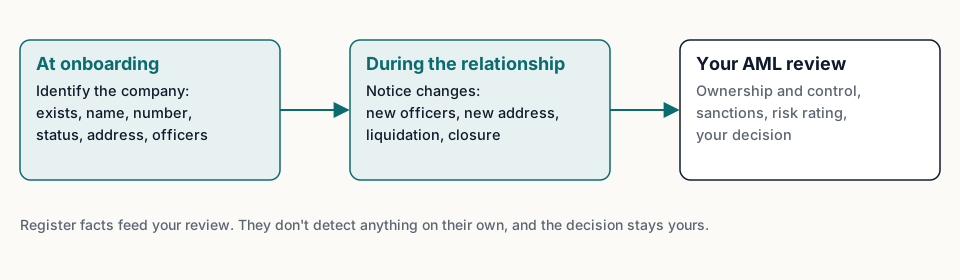
At the start of a relationship, the register answers the first questions about the company itself:
- Does it exist under the name and number the customer gave you?
- What is its exact legal name and legal form? Small differences matter when you match names against other lists.
- Where is its registered office? And does that match what the customer told you?
- Is it active? Or has it ceased, entered liquidation or closed?
- Who are its officers, as the register lists them, and in which roles?
Each of these is a fact the register states, with a date. A check that keeps the source and the date of each fact is one your team can show later.
Why do changes during the relationship matter?
A company that was fine at onboarding can change. Its officers change, it moves, it enters liquidation, it closes. Some of these changes are exactly what an AML review wants to notice: a new person in charge, a new address in another place, a company that has closed but whose account is still moving money.
A real example from the demo data on our home page: QILOVATIO ENERGIA IBERIA S.L., a Spanish company, was incorporated on 28 October 2025, and its extinction was registered on 15 May 2026. A check at the end of 2025 would have shown a new, open company; a check after May 2026 shows a closed one, with the act that says so.
{
  "id": "ES-RMHOJA-B-643957",
  "name": {"original": "QILOVATIO ENERGIA IBERIA S.L."},
  "status": {"value": "dissolved", "original_label": "Extinción", "as_of": "2026-05-15"},
  "incorporation_date": "2025-10-28",
  "provenance": {"source": "es_borme", "coverage_level": "events_only"}
}
So a register check isn't a one-off. Re-checking at review dates, or when something in the relationship changes, keeps the company facts in your file current.
What can't a register check do?
It's worth being plain about this, because company data is sometimes sold as more than it is.
- It doesn't detect money laundering. It confirms facts about a company. Spotting suspicious activity is your monitoring and your people's judgement.
- It doesn't tell you, on its own, who ultimately owns and controls the company. That needs other sources and your analysis.
- It doesn't screen sanctions or other lists.
- It doesn't decide. Whether to onboard, keep or report is your decision, under your procedures.
- It can't say more than the register records. If the register doesn't state a status, the honest answer is "unknown".
How do you keep each check explainable?
An AML file is read later, sometimes much later, by people who weren't there. For each company fact you rely on, keep:
- The source: which register, and a link to the record.
- The date you checked it, and the date the register gives for the fact if it has one.
- The register's own words: the original status label, not only your summary.
- What you couldn't check, and why: a country outside your sources, a register that doesn't publish something.
That's the format Fuentio uses for every answer: the source, its link, its licence, the check date, and the register's original labels next to the normalised ones. When a company is outside our coverage, the answer says "not covered by an automated source" and gives the official register's link, so your team knows what to check by hand.
Fuentio covers France and Spain; see what we cover. For the onboarding side, read what KYB is; for how registers differ across Europe, read company verification in Europe.
Limits. Register checks support an AML review; they don't replace it. Fuentio confirms what the official registers record in the countries it covers, with their sources. It doesn't provide sanctions screening, ownership analysis, accounts or ratings, and it doesn't make compliance decisions. In Spain it holds companies with a BORME act since 6 October 2025, with no search by NIF, CIF or VAT number.
Frequently asked questions
Does a company data API make me AML compliant?
No. It can do the register step well and keep its source. Compliance is your whole process, designed and owned by your team.
How often should I re-check a company?
Your risk assessment decides. Many teams re-check at each periodic review and when something in the relationship changes.
What if the register says nothing about a company's status?
Record "unknown", with the source, rather than assuming it's active. Then decide what else your process needs.
Can I rely on a register check done by a third party?
Ask what source it used, when it checked, and whether it gives you the register's link and words. A check you can't trace back is hard to defend.
Sources
- Directive (EU) 2015/849, on EUR-Lex: eur-lex.europa.eu
- Regulation (EU) 2024/1624, on EUR-Lex: eur-lex.europa.eu
- The FATF Recommendations: fatf-gafi.org
- The BORME act behind the example: boe.es