Every European country keeps an official register of its companies, but no two publish it the same way. Some put a free file online every night; some publish a gazette of events instead of a list; some ask you to sign a licence before you download anything. If you check companies in more than one country, these differences decide what you can automate, what you must do by hand, and what you're allowed to reuse.
This guide compares six official sources, using only facts we checked on each publisher's own pages: France, Spain, the United Kingdom, Ireland, Norway and Belgium.
What you'll learn
- The five ways registers differ: publisher, contents, rhythm, access and licence
- How six real registers compare, with their own terms
- Why "not in the file" doesn't always mean "doesn't exist"
- What to check before you build on a register's data
- Where Fuentio stands
Who publishes the register?
The first difference is the publisher, and it shapes everything else.
- In France, the identity of companies comes from Sirene, kept by INSEE, the national statistics institute, and the officers from the RNE, kept by INPI. The State's Annuaire des Entreprises brings them together with a free API.
- In Spain, the provincial commercial registries keep the companies' files, and the State's official bulletin, the BORME, published by the BOE, announces each registered act.
- In the United Kingdom, Companies House is the registrar and publishes the register itself.
- In Ireland, the Companies Registration Office (CRO) publishes a company file on its open-data portal.
- In Norway, Brønnøysundregistrene, the Brønnøysund Register Centre, publishes Enhetsregisteret, its register of legal entities.
- In Belgium, the Crossroads Bank for Enterprises (CBE, KBO or BCE), run by the Federal Public Service Economy, publishes its open data.
What does each one contain?
A register can be a list of companies, or a stream of events about them, and it can hold every company or only the active ones.
- France: the companies and their establishments, active or ceased, with the date.
- Spain: the BORME is a stream of acts (incorporations, appointments, dissolutions…). A company appears when an act about it is published.
- United Kingdom: Companies House's free file is a monthly snapshot of active companies only. Dissolved companies aren't in it.
- Ireland: the CRO's company file includes dissolved companies, each with its status; it has no officers.
- Norway: the nightly file holds the main units; officers and other roles are a separate dataset.
- Belgium: the full file holds the active registered entities; stopped ones aren't in it.
That's why the absence of a company proves little on its own. In the UK file, a missing company may have been dissolved; in the BORME, a company may simply have had no act published in the period you read.
How often does it change?
- France: the Annuaire des Entreprises is updated daily from Sirene and the RNE.
- Spain: the BORME is published Monday to Friday, in the morning.
- United Kingdom: the free file is monthly, published within five working days of the previous month's end.
- Ireland: the portal describes the file as daily; when we checked in October 2026, the latest file was five days old, so read the file's own date.
- Norway: the full file is produced every night, at about 05:00.
- Belgium: the full and update files are published every day and kept for 31 days.
How do you get the data?
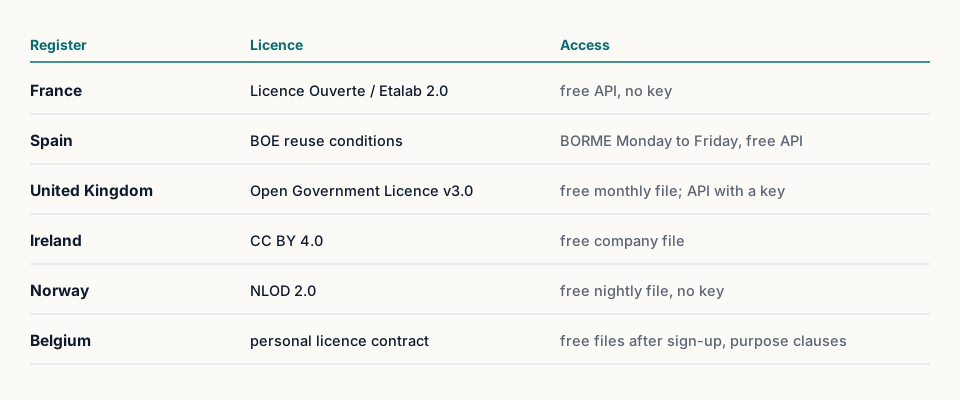
- France: a public API with no key, limited to 7 requests a second per IP address.
- Spain: the BOE's open-data API, with no key; the daily summary lists each province's document.
- United Kingdom: the monthly file with no key; the Companies House API needs a free account, an application and an API key, and allows 600 requests per five minutes. See how to check a UK company with Companies House.
- Ireland: a direct download of the company file. The portal's robots.txt excludes its API path, so read the rules before you script anything.
- Norway: a full download and a change feed, with no key.
- Belgium: the files are free, but you sign up first and accept a licence.
What does the licence let you do?
This is the difference that matters most if you build a product on the data.
- France: Licence Ouverte / Etalab 2.0, which allows reuse, commercial reuse included, if you cite the source and the date. INPI's RNE licence asks the same for officers' data.
- Spain: the BOE's reuse conditions allow commercial and non-commercial reuse, with the source cited and linked, the meaning not distorted, and the date of last update mentioned.
- United Kingdom: Companies House says it imposes "no rules or requirements on how the information on the public register is used"; its pages are under the Open Government Licence v3.0.
- Ireland: CC BY 4.0, "allowing unrestricted reuse with appropriate attribution", in the CRO's words.
- Norway: the Norwegian Licence for Open Government Data (NLOD) 2.0, which lets the licensee "use the information for any purpose and in all contexts", with attribution.
- Belgium: not a standard open licence but a personal contract. It limits reuse to the purpose you declare when you sign up, forbids using personal data for direct marketing, and makes you responsible for your own clients' compliance.
So "open data" covers very different things. Read the licence itself, not the portal's summary, and keep its link and the date you read it.
What should you check before building on a register?
A short list, whatever the country:
- Who publishes it, and is it the official source or a copy?
- Which companies are in it: all, or active ones only? Since when?
- How fresh is it, and where does the file show its own date?
- How do you access it: key, sign-up, robots rules, rate limits?
- What does the licence allow, and what must you pass on to your own customers?
- What about people: which personal data is in it, and what may you do with it?
Where does Fuentio stand?
In Europe, Fuentio reads two official sources today: France (the Annuaire des Entreprises, Sirene + RNE) and Spain (the BORME, company events since 6 October 2025). Every answer gives the source, the licence and the check date. See what we cover.
For the details of the two European sources we use, read French company registers explained and the Spanish BORME explained.
Limits. This guide compares six sources we checked on their publishers' own pages in October 2026; terms change, so read them again before you rely on them. Fuentio reads France and Spain only in Europe today. In Spain it can't look a company up by its NIF, CIF or VAT number.
Frequently asked questions
Is there one register for all European companies?
No. Each country keeps its own, with its own contents, rhythm, access and licence.
Is a company missing from a file really gone?
Not necessarily. Some files hold active companies only; an event stream like the BORME only shows companies with a recent act. Check the register itself.
Is "open data" always free to reuse commercially?
No. Most of the six sources here allow it with attribution, but Belgium's licence is a personal contract tied to the purpose you declare.
Which identifier should I store?
The register's own: SIREN in France, the registry sheet in Spain, the company number in the UK and Ireland, the organisation number in Norway, the enterprise number in Belgium.
Sources
- France: Annuaire des Entreprises API documentation and the Licence Ouverte dataset page
- Spain: the BOE's reuse conditions and open-data API
- United Kingdom: Companies House data products
- Ireland: CRO open data, companies
- Norway: Brønnøysundregistrene API documentation and NLOD 2.0
- Belgium: CBE open data