Company data APIs all promise the same thing: send a name or a number, get a company back. The differences only show when something goes wrong: a status nobody can trace, a country that was "covered" until you needed it, a licence that didn't allow what you built, an invoice you didn't expect. This checklist helps you find those differences before you sign up, whichever provider you look at, Fuentio included.
What you'll learn
- Six questions to ask any company data API, and why each matters
- What a good answer looks like, with real examples
- The red flags worth stopping at
- How to test a provider in an afternoon
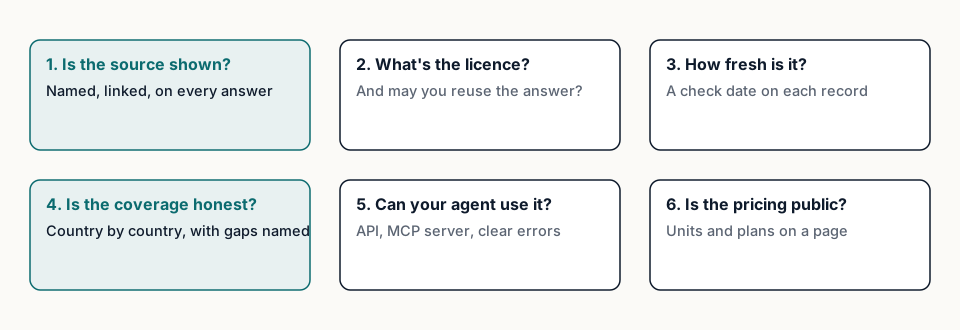
1. Is the source shown on every answer?
A company record is only as good as where it came from. Ask whether every answer names its source (which register or publication), links to it, and gives the source's own words for things like the status. "Our database" is not a source.
A good answer lets you open the official record yourself. For example, a French record should point to the official French source and give the identifier you can check there; a Spanish one should link to the official bulletin's page for each act.
Red flag: answers that merge several sources into one value with no trace of which said what.
2. What's the licence, and may you reuse the answer?
Official registers publish under very different terms: open licences that only ask for attribution, reuse conditions with specific wording, or personal contracts tied to a declared purpose. A provider that resells register data has to respect those terms, and so, often, do you.
Ask which licence applies to each source, what attribution it requires, and what you may do with the answers: store them, show them to your customers, combine them with other data. Keep the answer in writing.
Red flag: no licence named at all, or "proprietary data" for facts that come from a public register.
3. How fresh is it, and does each record say so?
Registers change every day: new companies, new officers, liquidations, closures. A provider may read a source live, refresh it daily, or work from a file that's months old. Each is fine for some uses and wrong for others.
Ask for a check date on every record, not a general claim about freshness. Ask what happens when the source is down: does the answer say it's serving an older copy, or does it hide it?
Red flag: no date on records, or a single "updated regularly" for every country.
4. Is the coverage honest?
This is the question that saves the most trouble. "We cover 100+ countries" can mean a full register in some, a handful of large companies in others, and a third-party file of unknown age in the rest.
Ask for coverage country by country, and region by region where a country has no single register. Some countries have several registers, by region or by kind of company, and not all publish under terms that allow reuse. A provider should be able to tell you which it reads, which it doesn't, and why. Here is how we show ours, on our coverage page: each covered source with its fields, update rhythm and licence, and what each answer leaves out.
Ask too what an answer says when a company is outside the coverage. "Not found" for a company the provider simply doesn't cover is misleading; a good answer says the company is outside its sources and points you to the official register.
Red flag: a single country count, no list of gaps, and "not found" used for "not covered".
5. Can your software and your AI agents use it?
Check the basics: clear documentation, consistent field names across countries, errors that say what went wrong and what to do next, and pagination that doesn't surprise you. If you use AI agents, check whether the provider offers an MCP server, and read its tool descriptions: an agent reads them to decide what to call.
Several company-data providers now offer an MCP server; that alone doesn't make one better. What matters is what the tools return: a plain answer with its source, or a wall of fields the agent has to interpret. To understand MCP itself, read what MCP is and why agents need it.
Red flag: errors without codes, field names that change by country, tools without descriptions.
6. Is the pricing public, and is it counted clearly?
You should be able to estimate your bill before you call anything. Ask what a unit is (a lookup, a search, a page of results, a document), what costs nothing (errors? coverage queries?), and what happens at your limit.
Public pricing is also a signal: a provider that publishes its plans has to stand behind them.
Red flag: "contact sales" for every plan, or units that cost different amounts depending on what the answer contains.
How do you test a provider in an afternoon?
Pick ten companies you know well: a few large ones, a few small ones, at least one that has closed, and at least one from a country the provider says it doesn't cover. Then:
- Look each one up by its official number, and search each one by name.
- Compare every answer with the official register, by hand.
- Note what each answer says about its source, licence and date.
- Note what happens for the closed company, and for the one outside coverage.
- Add up what those calls would cost on the plan you'd use.
An afternoon of this tells you more than any feature list. If you check companies for onboarding, read what KYB is to see where this fits in your process.
How does Fuentio answer these questions?
So you can test us the same way:
- Source: every answer names its source, links to it, and keeps the register's original labels.
- Licence: each source's licence is on our sources page and in every answer.
- Freshness: every record carries the date we checked it.
- Coverage: France and Spain; every gap listed on the coverage page. Outside it, the answer says "not covered by an automated source" and links the official register.
- Agents: a REST API and an MCP server, with tool descriptions written for agents. Both open soon.
- Pricing: plans and units on our pricing page.
Limits. A checklist can't tell you which provider is right for you; your own test can. Fuentio covers fewer places than providers that aggregate many sources: France and Spain. If you need countries outside that list, look elsewhere, and check their answers the same way.
Frequently asked questions
Should I pick the provider with the most countries?
Only if its coverage is real where you need it. Ask for the list, test the countries that matter to you, and check what "covered" means in each.
Is register data free anyway?
Many registers publish for free, under their own terms. A provider saves you reading each one, normalising it and keeping it fresh, but it should still show you the source.
Do I need an MCP server?
Only if AI agents will call the data. A REST API is enough for your own code; MCP makes the same tools easy for agents to find and call.
What's the most common surprise?
"Not found" that really means "not covered". Ask how a provider tells the two apart.
Sources
- Fuentio's coverage, country by country: coverage page
- Fuentio's sources and their licences: sources page
- Model Context Protocol: modelcontextprotocol.io