An AI model on its own knows what it learned in training, which stops at a date and was never a register of anything. When an agent has to check a fact that changes, such as whether a company is still active, it needs to ask a system that knows. The Model Context Protocol, MCP, is a common way for AI applications to do that.
What you'll learn
- What MCP is, in the words of its own documentation
- The three participants (host, client, server) and the three things a server can offer
- How an agent discovers and calls a tool
- Why a tool's answer should carry its source, and what MCP leaves to you
- How company data fits in, and where Fuentio stands today
What is MCP?
The protocol's documentation puts it simply: "MCP (Model Context Protocol) is an open-source standard for connecting AI applications to external systems." It compares MCP to a USB-C port for AI applications: one standard way to plug many things in.
Anthropic open-sourced MCP on 25 November 2024, describing it as "a new standard for connecting AI assistants to the systems where data lives". Since then many AI applications have added support for it; the documentation names Claude, ChatGPT, Visual Studio Code and Cursor among them.
Who are the participants?
MCP follows a client-server architecture with three roles, defined in its architecture overview:
- MCP host: "the AI application that coordinates and manages one or multiple MCP clients", for example Claude Desktop, Claude Code or Visual Studio Code.
- MCP client: "a component that maintains a connection to an MCP server and obtains context from an MCP server for the MCP host to use". The host creates one client per server.
- MCP server: "a program that provides context to MCP clients". It can run on your own machine or remotely.
What can a server offer?
The documentation defines three core primitives that servers expose:
- Tools: "executable functions that AI applications can invoke to perform actions", such as API calls or database queries.
- Resources: "data sources that provide contextual information", such as file contents or database records.
- Prompts: "reusable templates that help structure interactions with language models".
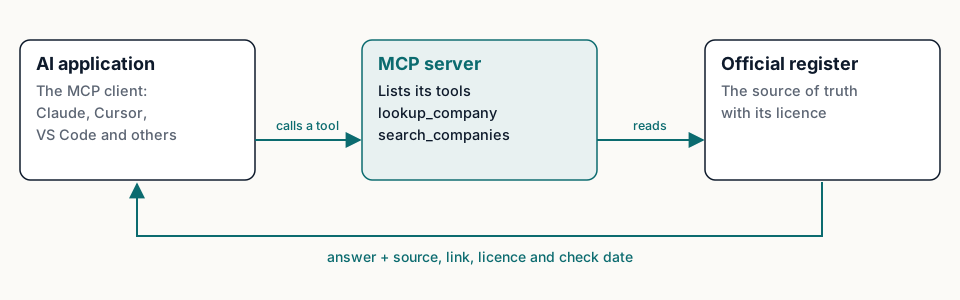
For company data, tools are the heart of it: "look this company up", "search companies with this name".
How does an agent call a tool?
Under the hood, MCP messages are JSON-RPC 2.0. A client first asks a server which tools it has with a tools/list request. Each tool comes back with a name, a title, a description and an input schema, so the model knows what the tool does and what to send. Then the client calls a tool with tools/call, the tool's name and its arguments, and gets back content the model can read.
The connection itself uses one of two transports. The stdio transport runs a server as a local process on the same machine. The Streamable HTTP transport reaches a remote server over HTTP and "supports standard HTTP authentication methods including bearer tokens, API keys, and custom headers".
Why do AI agents need sourced answers?
An agent that answers "this company is active" is useful only if you can check where that came from. A tool answer that says "active, according to this register, checked on this date, under this licence" can be shown to a colleague, an auditor or a customer. An answer without a source is a guess with good grammar.
That's the line Fuentio follows: every answer starts with one plain sentence and ends with its source. When the register doesn't say something, the answer says unknown rather than filling the gap. When a company is outside our coverage, the answer says so and gives the official register's link, so a person can check it by hand.
What should you check before connecting a server?
Adding an MCP server gives an AI application new abilities, so it deserves the same care as installing any software or sharing any key. A few questions help:
- Who runs it? A named organisation, with a contact and terms you can read.
- Where do its answers come from? For facts, a named source with a link, not "our data".
- What does it send back? Read a few real answers before you rely on them, including what it says when it doesn't know.
- What does it cost, and how is that counted? Per call, per unit, per month: know before your agent runs a loop.
- What can it do? A server that only reads is a different risk from one that can change things.
What doesn't MCP do for you?
MCP is a protocol: it carries the question and the answer. In its documentation's words, it "does not dictate how AI applications use LLMs or manage the provided context". In practice:
- It doesn't make an answer true. The server's source decides that.
- It doesn't decide what your agent does with the answer. A company check supports your own process; the decision stays with you.
- It doesn't choose your permissions. Which servers an agent may call, with which keys, is your setup.
How does company data fit in?
A company data server is a natural MCP use: the agent needs facts that change and that come from an official place. Fuentio is not the only company-data MCP server; several data providers now offer one, and you should compare what each covers and how it shows its sources.
Fuentio's server is built for that one job: official records for France and Spain, each with its source, licence and check date. Its tools, as listed on our page for AI agents:
list_coverage: what is covered, country by country (free)lookup_company: one company by its official number (1 unit)search_companies: companies by name (2 units)
The server's address will be https://api.fuentio.com/mcp, over Streamable HTTP. It opens soon.
To see what the answers rely on, read how French registers work, how the Spanish BORME works, and what we cover.
Limits. MCP carries answers; it doesn't check them. A company tool is only as good as its source and the honesty of its coverage: ask any provider which countries and regions it really covers, and where each answer comes from. Fuentio covers France and Spain, and nothing else today.
Frequently asked questions
Is MCP only for Claude?
No. It is an open standard; its documentation lists support in Claude, ChatGPT, Visual Studio Code, Cursor and others.
Do I need to code to use an MCP server?
Not for an existing server: most MCP hosts let you add one in their settings. Building a server is a development job, with SDKs in several languages.
Is MCP safe?
It depends on the servers you add and the permissions you give them. Read the protocol's security guidance and only connect servers you trust.
Can an agent make a compliance decision with MCP?
It can gather facts. The decision stays with you and your own process.
Sources
- Model Context Protocol, introduction: modelcontextprotocol.io
- MCP architecture overview: modelcontextprotocol.io
- Anthropic, "Introducing the Model Context Protocol" (25 November 2024): anthropic.com