France publishes a lot of open company data, but it is spread over several official sources with names that look alike: Sirene, the SIREN number, the SIRET number, the RNE. If you need to check a French company, it helps to know which source says what, and what none of them say.
What you'll learn
- What Sirene, the RNE and the Annuaire des Entreprises are, and who runs each one
- The difference between a SIREN and a SIRET number, with a real example
- What a company's status means in the French data, and why "ceased" is the right word
- How to look a company up yourself, free, from the official API
- What the official data does not cover
Who keeps France's company data?
Three official names come up again and again.
Sirene is the register kept by INSEE, France's national statistics institute. It identifies every legal unit and every establishment (each site where a unit works). Sirene gives the identity: the legal name, the legal category, the main activity code (NAF), the address, a headcount band, and whether the unit is active or has ceased.
The RNE (Registre national des entreprises) is kept by INPI, the French intellectual property office. Among other things, it holds the officers of a company: their names and their roles, as officially published.
The Annuaire des Entreprises is the French State's public directory of companies, run by DINUM, the State's digital agency. It brings Sirene and the RNE together in one place, with a free public API. This is the source Fuentio reads for France.
The data is published under the Licence Ouverte / Etalab 2.0, which allows reuse, including commercial reuse, as long as you name the source and the date of the data. The RNE has its own reuse licence from INPI, which asks the same: cite the source and the date of the last update.
What is the difference between a SIREN and a SIRET?
This is the question French company data raises most often, and INSEE answers it precisely.
A SIREN is a nine-digit identifier given to each legal unit. In INSEE's words, the first eight digits have no meaning and the ninth is a check digit. A SIREN is given only once and is never reused, even after the company disappears.
A SIRET is an establishment identifier of 14 digits. It is made of two parts: the SIREN of the legal unit the establishment belongs to, then the NIC, a four-digit order number for the establishment plus one check digit.
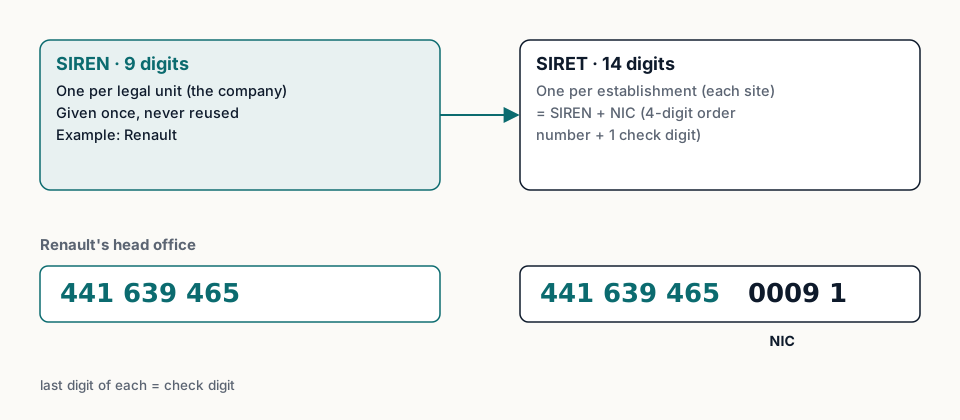
Take Renault. Its SIREN is 441639465. Its head office has the SIRET 44163946500091: the same nine digits, then the NIC 00091. A company has one SIREN and as many SIRETs as it has establishments.
Two more numbers carry the SIREN inside them. The French VAT number is "FR", a two-character key, then the SIREN: Renault's is FR63441639465. And when you look a company up by SIRET, it makes sense to resolve it to the company's SIREN, since the legal facts (name, legal form, status) belong to the legal unit, not to one site.
Which number should you ask a French customer for?
Ask for the SIREN. It identifies the company itself, it never changes and it is never reused, so it is the right key for your records. If a customer gives you a SIRET (it appears on invoices and forms), its first nine digits are the SIREN. If they give you a French VAT number, the SIREN is in it too, after the "FR" and the two-character key.
Keep the number as text, not as a number in a spreadsheet: long digit strings are where spreadsheets quietly change data. And check the ninth digit: it is a check digit, so a typo usually shows.
What does a company's status mean?
Sirene distinguishes two administrative states: active, or ceased. A ceased unit comes with the date the register gives for it.
The word matters. In everyday English it is tempting to call a closed company "dissolved", but the register doesn't say that: it says the unit has ceased, and gives a date. A dissolution is a legal event with its own procedure; Sirene records the end of the activity, not the legal steps behind it. That's why Fuentio shows "ceased", with the register's date, and nothing more.
A real example: PEUGEOT SA, SIREN 552100554, shows as ceased, with the date 2021-01-16.
How can I look up a French company myself?
The Annuaire des Entreprises has a public API that needs no key: recherche-entreprises.api.gouv.fr. Its documentation says it accepts up to 7 requests a second per IP address, and that this is a maximum, not a guaranteed rate. The same endpoint does both a direct lookup (by SIREN or SIRET) and a search by name.
With cURL:
curl "https://recherche-entreprises.api.gouv.fr/search?q=441639465&per_page=1"With Python (requests):
import requests

r = requests.get(
    "https://recherche-entreprises.api.gouv.fr/search",
    params={"q": "441639465", "per_page": 1},
    timeout=10,
)
company = r.json()["results"][0]
print(company["siren"], company["nom_raison_sociale"], company["etat_administratif"])
With JavaScript (fetch):
const url = "https://recherche-entreprises.api.gouv.fr/search?q=441639465&per_page=1";
const data = await (await fetch(url)).json();
const company = data.results[0];
console.log(company.siren, company.nom_raison_sociale, company.etat_administratif);
A few field names worth knowing in the answer: siren, nom_raison_sociale (the legal name; nom_complet adds the acronym), nature_juridique (the four-digit INSEE legal category), etat_administratif (A for active, C for ceased), date_creation, activite_principale (the NAF code, such as 64.20Z), siege.siret and siege.adresse for the head office, and tva for the VAT number when it is returned.
, with the source, the licence and the check date on every answer. Set your key in an environment variable first (FUENTIO_API_KEY).
curl https://api.fuentio.com/v1/companies/FR/441639465 -H "Authorization: Bearer $FUENTIO_API_KEY"import os, httpx
r = httpx.get("https://api.fuentio.com/v1/companies/FR/441639465",
headers={"Authorization": f"Bearer {os.environ['FUENTIO_API_KEY']}"})
print(r.json())5 <!-- endif -->
What does a normalised French record look like?
Here is part of the real record Fuentio keeps for Renault, from the data shown in the demo on our home page. The original French values stay next to the normalised codes:
{
  "id": "FR-SIREN-441639465",
  "name": {"original": "RENAULT"},
  "status": {"value": "active", "original_label": "Active", "as_of": "2025-12-06"},
  "legal_form": {"original_code": "5510", "original_label": "SA nationale à conseil d'administration", "elf_code": "1NF1"},
  "identifiers": [
    {"scheme": "FR_SIREN", "value": "441639465", "primary": true},
    {"scheme": "FR_SIRET", "value": "44163946500091", "primary": false},
    {"scheme": "EU_VAT", "value": "FR63441639465", "primary": false}
  ],
  "activity": {"original_code": "64.20Z", "nace_rev2": "64.20", "label_en": "Activities of holding companies"},
  "incorporation_date": "2002-04-01",
  "provenance": {"source": "fr_recherche_entreprises", "source_updated_at": "2026-10-05"}
}
Every answer names its source, links to it, gives its licence and the date it was checked. If the register doesn't say something, the answer says unknown rather than guessing. The same approach covers Spain's company events: see what we cover, or read how the Spanish BORME works and what KYB means.
Limits. The French data has no insolvency proceedings in this source, and no capital amount. Companies that opted out of public diffusion are left out by the source, and so by us. Officers come with their names and roles only: birth dates and nationality are never read. There is no search by a person's name.
Frequently asked questions
Is a SIREN enough to identify a French company?
Yes: one SIREN per legal unit, never reused. A SIRET points to one establishment of that unit; its first nine digits are the SIREN.
Is the official API free?
The Annuaire des Entreprises API needs no key. Its documentation sets a maximum of 7 requests a second per IP address.
Why does Fuentio say "ceased" and not "dissolved"?
Because that is what the register says: active or ceased, with a date. A dissolution is a legal step the register doesn't report here.
Can I reuse the data commercially?
The Licence Ouverte / Etalab 2.0 and INPI's RNE licence allow it, as long as you cite the source and the date of the data. Read the licences themselves before you build on them.
Sources
- INSEE, definition of the SIREN number: insee.fr
- INSEE, definition of the SIRET number: insee.fr
- Annuaire des Entreprises: annuaire-entreprises.data.gouv.fr and its API documentation
- Licence Ouverte / Etalab 2.0, on the dataset page: data.gouv.fr
- INPI's RNE reuse licence: inpi.fr