When your customer is a company rather than a person, you need to know who you're dealing with: does the company exist, is it still active, who represents it, and is it who it says it is. That work is called KYB, "know your business". It sounds like paperwork, and much of it is. But a few checks against official sources do a large part of it, and they are easy to get right once you know what each source can and can't tell you.
This guide explains the idea in plain words. It isn't legal advice: what you must check, and how, depends on your country, your sector and your own risk assessment.
What you'll learn
- What KYB means, and how it differs from KYC
- Why businesses do it, including where anti-money-laundering rules come in
- The usual steps, and where an official register fits
- What a register check can confirm, and what it can't
- How to keep the decision yours while doing fewer manual checks
What is KYB?
KYB is the set of checks a business runs on another business before or while working with it: a bank opening an account for a company, a marketplace accepting a seller, a payment provider onboarding a merchant, a supplier extending credit terms to a new client.
KYC, "know your customer", is the same idea for individuals. KYB adds what's specific to companies: a company is a legal construction, registered somewhere, with people acting for it and owners behind it. So KYB asks two kinds of questions. About the company itself: does it exist, under which name and number, is it active, where is it registered, what does it do? And about the people around it: who runs it, and who owns and controls it?
Why does KYB matter?
There are two reasons, and they overlap.
The first is your own interest. Working with a company that doesn't exist, has closed, or isn't the one it claims to be costs time and money: unpaid invoices, chargebacks, goods sent to nobody, contracts signed by someone without the power to sign. A quick look at the official register catches the simplest cases early.
The second is the law, for some businesses. In the European Union, the anti-money-laundering rules, such as Directive (EU) 2015/849 and the newer Regulation (EU) 2024/1624, require the businesses they cover (banks, payment firms and other "obliged entities") to identify their customers, legal entities included, verify that identity, and understand who owns and controls them. Internationally, the Financial Action Task Force sets the standards these rules build on, in the FATF Recommendations. Whether these rules apply to you, and exactly how, is a question for your compliance team or your lawyer.
What are the usual steps?
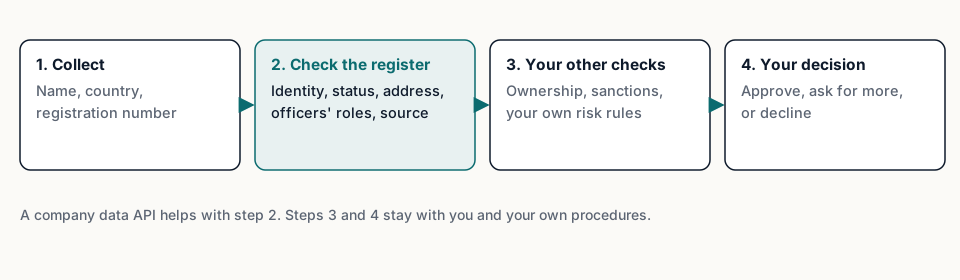
Every organisation designs its own process, but most KYB flows look like this:
- Collect the basics from the customer: the legal name, the country, the registration number.
- Check the register: confirm the company exists under that number, read its legal name, status, registered address, legal form and the roles of its officers, and keep the source.
- Run your other checks: ownership and control, sanctions and other lists, the documents you require, your own risk rules.
- Decide: approve, ask for more, or decline, and keep a record of why.
What can an official register confirm?
An official register is the reference for the facts it records. Depending on the country, a register check can confirm:
- that a company exists under a given number;
- its legal name, legal form and registered address;
- whether it is active, ceased, in liquidation or closed, with the date the register gives;
- the roles of its officers, as officially published;
- and, with history, what changed and when.
Each country words these facts differently. In France, a company that has stopped shows as "ceased", with its date; see how French registers work. In Spain, the BORME publishes acts, and the status comes from those acts: a dissolution opens a liquidation, an extinction closes the company; see the Spanish BORME explained. ## What can't a register check do?
A register check is one step, not the whole process.
- It doesn't tell you whether the person you're talking to is entitled to act for the company. It tells you who the register lists.
- It doesn't screen sanctions or other lists.
- It doesn't tell you, on its own, who ultimately owns and controls the company: that needs other sources and your own analysis.
- It can't tell you more than the register records. If a register doesn't state a status, the honest answer is "unknown", not "active".
- It doesn't decide. The decision, and the responsibility for it, stay with you.
Where does a company data API help?
At step 2. Checking a register by hand means a different website for each country, a different number format, a different word for "closed", and a screenshot to keep as proof. An API that reads the official registers and returns one format does that step with fewer manual checks, and keeps the source with every answer.
That's what Fuentio does, for France and Spain (see what we cover). Every answer gives the source, a link to it, the licence and the date we checked it. When a company is outside our coverage, the answer says "not covered by an automated source" and gives the official register's link, so your team knows when to check by hand. Fuentio supports your checks; it doesn't make compliance decisions.
What does a sourced answer look like?
Here is part of a real Spanish record from the demo on our home page. It shows why the status and its source matter: this company was incorporated in October 2025, and its extinction was registered in May 2026.
{
  "id": "ES-RMHOJA-B-643957",
  "name": {"original": "QILOVATIO ENERGIA IBERIA S.L."},
  "status": {"value": "dissolved", "original_label": "Extinción", "as_of": "2026-05-15"},
  "incorporation_date": "2025-10-28",
  "provenance": {"source": "es_borme", "coverage_level": "events_only"}
}
A team onboarding this company today would see, in one answer, that it is closed, since when, and the BORME page that says so.
AI agents can run the same check in the middle of a task; see what MCP is and why agents need it.
Limits. A register check confirms what the register records, nothing more. Fuentio covers France and Spain. In Spain it covers companies with a BORME act since 6 October 2025, without looking companies up by NIF, CIF or VAT number. It doesn't provide sanctions screening, ownership analysis or accounts, and it doesn't make the decision for you.
Frequently asked questions
What's the difference between KYB and KYC?
KYC checks individuals; KYB checks businesses, which adds the company itself (its registration, status, address) and the people who run, own and control it.
Is KYB a legal obligation?
For some businesses, yes, under anti-money-laundering rules; for others it's simply good practice. Ask your compliance team or your lawyer what applies to you.
Can an API do KYB for me?
An API can do the register step quickly and keep its source. The other checks and the decision stay with your process.
What if a company isn't in the register I check?
Don't conclude it doesn't exist. Check the official register of its country by hand; Fuentio gives you that link when a company is outside its coverage.
Sources
- Directive (EU) 2015/849, on EUR-Lex: eur-lex.europa.eu
- Regulation (EU) 2024/1624, on EUR-Lex: eur-lex.europa.eu
- The FATF Recommendations: fatf-gafi.org
- The official registers Fuentio reads, with their licences: our sources page