On a French company's record, an invoice or a registration document, you'll meet a code made of four digits and a letter: 64.20Z, 62.01Z, 47.11F. That's the APE code, the company's main activity according to INSEE's French classification of activities (NAF). This guide explains how to read it, what it's for, how to find it for any company, and what changes with NAF 2025.
The dates below come from insee.fr, read on 8 October 2026.
What you'll learn
- The difference between the APE code and the NAF code
- How to read a code, from section to subclass
- What the APE code is useful for, and what it doesn't tell you
- How to find a company's code
- What NAF 2025 changes on 1 January 2027
APE and NAF: two names for one code
NAF (nomenclature d'activités française) is the French classification of activities: the structured list of economic activities, kept by INSEE, France's national statistics institute. According to INSEE, it has the same structure as the European classification of activities, NACE, itself derived from the international classification ISIC (CITI in French).
The APE code (activité principale exercée, "main activity carried out") is the NAF code given to a company or an establishment to describe its main activity. People say "APE code" when they talk about a company and "NAF code" when they talk about the classification, but it's the same code.
If you work across Europe, this matters: the first four digits of a NAF code line up with the NACE class used in every EU country. Spain's CNAE follows NACE in the same way, so a French and a Spanish company in the same NACE class do comparable things.
Reading a code, from broad to precise
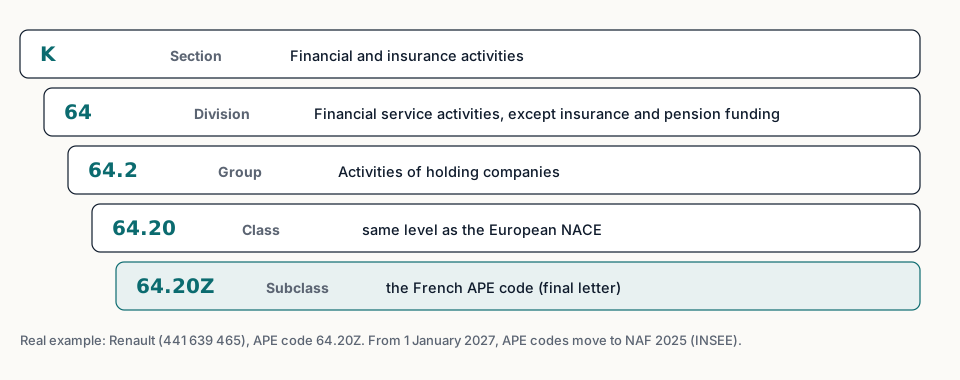
A NAF code reads on five levels, from the most general to the most precise. Take Renault's, 64.20Z, as INSEE's classification describes it:
- Section K: financial and insurance activities (a letter).
- Division 64: financial service activities, except insurance and pension funding (two digits).
- Group 64.2: activities of holding companies.
- Class 64.20: the level that matches the European NACE.
- Subclass 64.20Z: the French subdivision, marked by the final letter. That's the APE code.
So Renault's APE code says that the main activity recorded for the company is that of a holding company.
What the APE code is useful for
The APE code sorts companies by activity. In practice, people use it to:
- segment a file of customers or prospects by sector;
- understand quickly what an unfamiliar company does;
- compare a company with its sector in public statistics;
- spot an inconsistency: a building contractor whose APE code describes an unrelated activity deserves a question.
It also has limits. The code describes the main activity recorded, not every activity. It may no longer match what the company does today; INSEE offers a procedure to ask for it to be changed. And each establishment has its own code: a group's head office can be a holding company (64.20Z) while its plants carry an industrial code.
For checks on suppliers or customers, treat the code as a hint, not a verdict. A mismatch between the code and what a company tells you it does is a reason to ask, not a reason to refuse: many companies have a main activity on record that only partly describes what they sell.
Finding a company's APE code
By hand. On the Annuaire des Entreprises, the French State's public company directory, type the SIREN, SIRET or name: the page shows the company's main activity and each establishment's.
Understanding a code. INSEE's NAF classification gives each code's label and explanatory notes: what it includes and what it doesn't.
Through an API. Fuentio's API will return the activity with the original code and its European NACE equivalent, with the source and check date, when it opens.
For where the activity sits among the other data in a French company record, read the French company registers explained.
What NAF 2025 changes
INSEE has adopted a new classification, NAF 2025, approved by decree no. 2025-736 of 31 July 2025. According to INSEE's page (updated on 12 February 2026):
- From 1 January 2027, NAF 2025 becomes the reference classification for assigning APE codes. On that date, every active legal unit in the Sirene directory and its establishments will have a modified APE code.
- Throughout 2026, the sirene.gouv.fr website shows companies their future APE code in NAF 2025 for all their establishments, and lets them ask for a correction if needed.
In practice, if you store APE codes, expect all of them to change on 1 January 2027. INSEE publishes a correspondence table between NAF rev. 2 and NAF 2025. Rather than converting old codes yourself, read each company's code again from the official data after the switch: INSEE assigns the new code.
If your systems use APE codes for anything that matters, such as pricing, eligibility rules or reporting, list those uses now. Each will need a decision: map old codes to new ones, re-read every company, or keep both for a transition period. Making that list before January is far easier than after.
See what we cover in France and Spain, and how company data fits into KYB.
Limits. The APE code describes the main activity INSEE has on record, not all of a company's activities, and may no longer match what it actually does. The NAF 2025 dates come from insee.fr, read on 8 October 2026. Not legal advice.
Frequently asked questions
Can a company change its APE code?
Yes: INSEE offers a procedure to ask for the APE code to be changed, and, for NAF 2025, a request to correct the future code on sirene.gouv.fr during 2026.
Is the APE code the same for every establishment?
No: each establishment has its own main-activity code, which can differ from the company's.
What happens to APE codes on 1 January 2027?
According to INSEE, every active legal unit and its establishments will have a modified APE code, expressed in NAF 2025.
Where can I find a code's label?
In the NAF classification published by INSEE, which also gives each code's explanatory notes.
Sources
- INSEE, "Nomenclature d'activités française" (updated 30/07/2025, read on 8 October 2026): insee.fr
- INSEE, "Vers une nouvelle nomenclature : la NAF 2025" (updated 12/02/2026, read on 8 October 2026): insee.fr
- INSEE, subclass 64.20Z: insee.fr
- Decree no. 2025-736 of 31 July 2025: legifrance.gouv.fr
- Annuaire des Entreprises: annuaire-entreprises.data.gouv.fr