The general move to electronic invoicing between businesses took effect in France on 1 September 2026. Among the data an e-invoice must carry, one concerns your customer file directly: each customer's SIREN, the nine-digit number that identifies a French company. An invoice with a wrong SIREN risks not reaching the right recipient. This guide sets out the official calendar, explains the role of the customer's SIREN, and shows how to check a customer file before errors start blocking invoices.
Every date and duty below comes from impots.gouv.fr, the French tax administration's site, read on 8 October 2026. They can change: always check the official page.
What you'll learn
- The reform's official calendar, as the administration publishes it
- Why the customer's SIREN is one of the mandatory data
- What happens when the directory can't find your customer
- How to check the SIRENs in your customer file, step by step
- What a register check doesn't do for your compliance
The official calendar
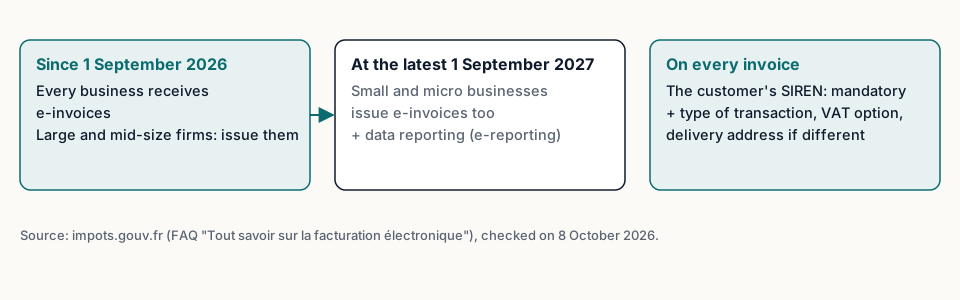
According to the official FAQ "Tout savoir sur la facturation électronique" ("All about e-invoicing") published on impots.gouv.fr:
- Since 1 September 2026, every business, whatever its size, must be able to receive electronic invoices. Large companies, mid-size companies (ETI) and public administrations issue their invoices this way.
- At the latest on 1 September 2027, the duty to issue e-invoices extends to medium, small and micro businesses. It comes with a duty to send invoicing, transaction and payment data to the administration.
The page "Je passe à la facturation électronique" on impots.gouv.fr, updated on 1 September 2026, confirms that the general move is "effective since 1 September 2026". The same FAQ says the administration will be lenient with businesses that run into difficulties at the start. That leniency doesn't change the dates.
Why the customer's SIREN matters so much
An e-invoice isn't a file attached to an email. The official FAQ explains that it carries data sent in a structured format, and that four of them exist "to route invoices correctly":
- the customer's SIREN;
- the type of transaction (sale of goods, services, or both);
- the option chosen for paying VAT;
- the delivery address of goods, when it differs from the customer's address.
The reason is practical. E-invoicing relies on a business directory, run by the administration, that automatically routes each invoice to the recipient's reception platform. The SIREN is what finds that recipient. A wrong SIREN means an invoice that goes elsewhere, or nowhere.
When the directory can't find your customer
The administration's practical start-up guide describes what to do when the directory can't identify a customer's platform. The business must first check the information it used: SIREN, SIRET, receiving establishment, company name, contract data or data the customer provided. It then turns to its platform or provider and, if the problem persists, to its customer, and must keep a record of the steps taken.
In other words, the first check the administration asks for is one you can do before you even issue an invoice: is your customer's SIREN the right one, and is the company still active?
Check the SIRENs in your customer file
A customer file collects errors over time: mistyped SIRENs, the head office's SIRET stored in place of the SIREN, companies that have ceased, companies that changed their name. Here's a simple way to clean it.
1. Extract and normalise. Export the identifier column. Strip spaces and dots, and keep the numbers as text: a spreadsheet drops leading zeros if you store them as numbers. When you find 14 digits, it's a SIRET, and its first nine digits are the SIREN.
2. Check the digits. The ninth digit of a SIREN is a check digit (the Luhn algorithm). An offline check catches most typing errors without any network call. The code is in our tutorial on SIREN, SIRET and VAT formats.
3. Check against the official data. For each valid SIREN, confirm that the company exists, that it's active, and that its name matches the one in your file. The Annuaire des Entreprises, the State's public directory, does this by hand; for a large file, an API does the same work. A valid SIREN that finds nothing may belong to a company that opted out of public listing: ask the customer for a registration document.
4. Sort the differences. Group the results: wrong SIRENs to correct, ceased companies to remove or to check with your sales team, different names to confirm, closed establishments to replace with the right SIRET. For the difference between a closed establishment and a ceased company, read how to check whether a French company is still active.
5. Ask your customers. For the doubtful cases, ask directly: customers know their own SIREN, and the exchange gives you a record.
Plan the clean-up before the dates that apply to you, not after. A file of a few thousand customers usually has a handful of problems that take time to resolve: customers who don't answer, companies that merged, records that point to a site rather than the company. Starting early means the first e-invoices go to the right place.
What a register check doesn't do
Checking your customers' SIRENs reduces misrouted invoices. It doesn't make your business compliant with the reform: you also need to choose an approved platform and adapt your invoicing software and processes. Fuentio offers neither a platform nor compliance; it gives a company's official identity, with its source.
The same discipline helps outside invoicing too. A customer file with correct, current SIRENs makes KYB checks easier, keeps reminders and contracts addressed to the right company, and shows quickly which customers have ceased. Spain has its own calendar and its own key field, the NIF: see e-invoicing in Spain.
See what we cover in France and Spain.
Limits. The dates and duties cited come from impots.gouv.fr, read on 8 October 2026; they can change. A register check confirms a SIREN, a status and a name, not a customer's reception platform. Fuentio doesn't make anyone compliant with the reform. Not legal or tax advice.
Frequently asked questions
I run a micro business: must I issue e-invoices from 2026?
According to impots.gouv.fr, every business must be able to receive e-invoices since 1 September 2026; the duty to issue them extends to small and micro businesses at the latest on 1 September 2027. Check your situation on the official page.
Is the SIRET enough instead of the SIREN?
The official FAQ lists the customer's SIREN among the mandatory data. A SIRET contains the SIREN (its first nine digits) and identifies the establishment, which can help route an invoice to a particular site.
Is an invoice attached to an email an e-invoice?
No: the official FAQ says an e-invoice is issued, sent and received in a digital format that allows automated processing. A file attached to an email doesn't qualify.
Where can I check a SIREN for free?
On the Annuaire des Entreprises, the French State's public company directory.
Sources
- impots.gouv.fr, "Je passe à la facturation électronique" (updated 01/09/2026, read on 8 October 2026): impots.gouv.fr
- impots.gouv.fr, FAQ "Tout savoir sur la facturation électronique" (read on 8 October 2026): impots.gouv.fr
- impots.gouv.fr, practical start-up guide for 1 September 2026 (read on 8 October 2026): impots.gouv.fr
- Annuaire des Entreprises: annuaire-entreprises.data.gouv.fr