Two changes to invoicing are under way in Spain, and they're often confused. Verifactu sets requirements for the software businesses use to issue their invoices. Mandatory B2B e-invoicing, which comes from the "Crea y Crece" law, requires businesses to exchange invoices in a structured electronic format. This guide sets out the official calendar for each, the customer data they require, and what the company register can contribute.
Every date comes from the BOE (Spain's official gazette) and the Agencia Tributaria (the tax agency), read on 8 October 2026. These dates have moved before and may move again: always check the official source.
What you'll learn
- Verifactu's official calendar, after its extension
- The calendar for B2B e-invoicing (Royal Decree 238/2026)
- Which customer data an e-invoice must carry
- What the company register gives you, and what it doesn't
- How to prepare your customer file
Two duties, two calendars
Verifactu: invoicing software
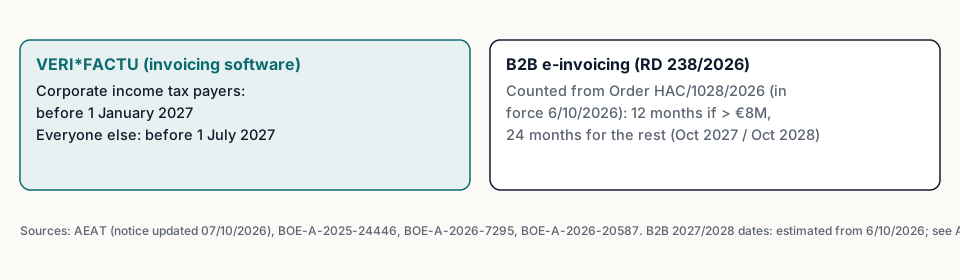
The regulation on invoicing software systems (Royal Decree 1007/2023) sets the requirements invoicing software must meet. The deadline to comply was extended by Royal Decree-law 15/2025 of 2 December. According to the Agencia Tributaria's notice (updated on 7 October 2026):
- Entities that file corporate income tax (Impuesto sobre Sociedades) must have adapted their systems before 1 January 2027.
- All other taxpayers, before 1 July 2027.
The same notice describes the period before those dates as a test period.
B2B e-invoicing
Law 18/2022 on the creation and growth of companies ("Crea y Crece") extended the duty to issue and send electronic invoices to dealings between businesses and professionals. It was put into practice by Royal Decree 238/2026 of 25 March (BOE, 31 March 2026). The duty takes effect counting from the entry into force of a ministerial order on the technical details:
- Twelve months later for businesses and professionals whose volume of operations exceeded €8 million in the previous calendar year.
- Twenty-four months later for everyone else.
That order is Order HAC/1028/2026 of 2 October, published in the BOE on 5 October 2026. It enters into force the day after publication and starts the count. That puts the two milestones in October 2027 and October 2028, estimated from the order's entry into force (6 October 2026); check the Agencia Tributaria for official dates.
Which customer data an e-invoice needs
According to Royal Decree 238/2026, an e-invoice must correctly carry the issuer's NIF (tax identification number) and the recipient's NIF, and a unique code that includes the issuer's NIF, the invoice number and series, and its issue date. Issuer and recipient must also report the invoice's status as it changes.
In practice, the key piece of data about your customer is their NIF. An invoice with the wrong NIF is a wrongly identified invoice. The NIF and the registry identity answer different questions: the NIF says who the tax agency knows, the registry says what the commercial registry has recorded about the company. A clean customer file holds both, each with where it came from.
What the company register gives you, and what it doesn't
To be clear: Fuentio doesn't check NIFs. For Spain, Fuentio reads the BORME, the official gazette that publishes the acts registered in the commercial registry, and the BORME doesn't include the tax number. You can't look a Spanish company up by its NIF or CIF in Fuentio.
What the register does give you, from the published acts:
- The exact company name, as it was registered, useful to check that the legal name in your file is right.
- Its existence and its changes: incorporation, name change, move of the registered office, extinction. A company that has been extinguished shouldn't stay in your file of active customers.
- The registered office, to compare with your file.
The NIF, on the other hand, has to come from your customer: from their documents, their own invoices or the contract. For what the BORME publishes and how to read it, see how to read the BORME.
How to prepare your customer file
- Keep the two apart. Store the NIF (which your customer gives you) and the registry identity (company name, province and registry sheet) in separate fields. They come from different sources and change for different reasons.
- Ask for the NIF in writing from customers who haven't given it, and note where it came from.
- Compare the company name with the register: search for the company by name and confirm the province and sheet.
- Review recent changes. A name change or a move of the registered office means updating the record; an extinction means closing it.
- Repeat the review before the dates that apply to you, and regularly after that.
Starting early pays off. The B2B duty applies to the customer data you hold for every business you invoice, and the slowest part of a clean-up is usually waiting for customers to confirm their details. A file reviewed months before your date leaves time for the cases that need a conversation.
The same discipline helps in France, where the key field is the customer's SIREN: see French e-invoicing and your customers' SIREN. See what we cover in France and Spain.
Limits. The dates and duties cited come from the BOE and the Agencia Tributaria, read on 8 October 2026; the October 2027 and 2028 dates are estimated from the order's entry into force (6 October 2026); check the Agencia Tributaria for official dates. Fuentio doesn't check NIFs or CIFs and doesn't make anyone compliant with Verifactu or e-invoicing: it shows the acts published in the BORME. Not legal or tax advice.
Frequently asked questions
Are Verifactu and e-invoicing the same thing?
No. Verifactu regulates the software used to issue invoices; B2B e-invoicing regulates the format and exchange of invoices. They have different calendars.
When does B2B e-invoicing apply to me?
According to Royal Decree 238/2026, twelve months after the implementing order came into force if your volume of operations exceeded €8 million the previous year, and twenty-four months after in other cases.
Can I check a customer's NIF with Fuentio?
No. The BORME doesn't include the NIF. Fuentio shows the name, registered office and published acts of Spanish companies.
Which Verifactu date applies to me?
If your entity files corporate income tax, before 1 January 2027; if not, before 1 July 2027, according to the Agencia Tributaria.
Sources
- Agencia Tributaria, notice on the extended deadline for invoicing systems (updated 07/10/2026, read on 8 October 2026): sede.agenciatributaria.gob.es
- Royal Decree-law 15/2025 of 2 December (BOE-A-2025-24446): boe.es
- Royal Decree 238/2026 of 25 March (BOE-A-2026-7295): boe.es
- Order HAC/1028/2026 of 2 October (BOE-A-2026-20587): boe.es
- Law 18/2022 on the creation and growth of companies: boe.es