Every working day, Spain's BORME (Boletín Oficial del Registro Mercantil, the official gazette of the commercial registry) publishes the acts that the provincial commercial registries have just registered: companies incorporated, directors appointed and removed, registered offices moved, capital increased, mergers, extinctions. Read one by one, they tell the story of a company. This guide explains how to read an entry and what each type of act means, with a real example for each.
If you first need to know what the BORME is, read the Spanish BORME explained.
What you'll learn
- How to read a BORME entry: reference, dates, registry sheet
- The most common acts, grouped by family
- A real example of each act, with its reference on the BOE
- What the BORME doesn't say, and how not to over-read it
- How to follow a company's changes
How to read an entry
Each entry in section A of the BORME concerns one company and can contain several acts registered at the same time. Three pieces of information place it:
- The document reference, for example BORME-A-2026-96-08: the year, the gazette's issue number and, at the end, the code of the registry's province (08 is Barcelona, 28 Madrid, 48 Bizkaia in this guide's examples).
- Two dates: the date the act was registered at the provincial registry, and the date it was published in the BORME, usually a few days later.
- The registry data: the company's sheet (hoja) in the commercial registry, for example B-56855 in Barcelona, which identifies it in a stable way.
The BORME doesn't publish companies' tax numbers (NIF). To identify a Spanish company from the BORME, the registry sheet and the province are the reference.
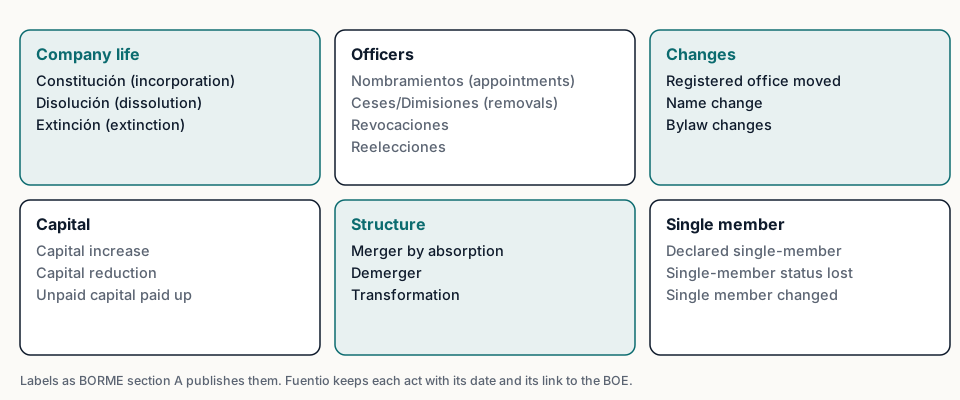
Company life
Constitución (incorporation). The company is born in the registry. Real example: GEELY AUTO ESPAÑA SL, registered on 22 December 2025 and published on 30 December 2025 (BORME-A-2025-248-28). The same entry also carries a declaration that the company has a single member and the appointment of a sole director: an incorporation often comes with several acts.
Disolución (dissolution). Opens the company's liquidation: it stops normal business and winds up its assets. It isn't the end. Our demo data has no example.
Extinción (extinction). Closes the company in the registry. Real example: QILOVATIO ENERGIA IBERIA S.L., registered on 15 May 2026 and published on 25 May 2026 (BORME-A-2026-97-08).
Officers
Nombramientos, reelecciones, ceses y dimisiones, revocaciones (appointments, re-elections, removals and resignations, revocations): directors, board members, attorneys and auditors joining and leaving, with their role.
- Appointments, revocations and "otros conceptos" (other matters): AENA S.M.E. SA, registered on 18 February 2026 and published on 25 February 2026 (BORME-A-2026-38-28).
- Removals and resignations: GEELY AUTO ESPAÑA SL, published on 15 April 2026 (BORME-A-2026-71-28).
- Re-elections: AENA S.M.E. SA, published on 28 May 2026 (BORME-A-2026-100-28).
Cancelaciones de oficio de nombramientos. The registry itself cancels the registration of officer appointments. Real example: IBERDROLA SOCIEDAD ANONIMA, published on 11 June 2026 (BORME-A-2026-110-48).
The entries name people and their roles. Fuentio keeps only names and roles as published, and this guide shows no names.
Changes
- Cambio de domicilio social (registered office moved): GEELY AUTO ESPAÑA SL, published on 28 April 2026 (BORME-A-2026-80-28).
- Modificaciones estatutarias (bylaw changes): AENA S.M.E. SA, published on 29 May 2026 (BORME-A-2026-101-28).
- Cambio de denominación (name change) and cambio de objeto social (change of business purpose): no example in our demo data.
Capital
- Ampliación de capital (capital increase): GEELY AUTO ESPAÑA SL, published on 16 April 2026 (BORME-A-2026-72-28).
- Reducción de capital (capital reduction) and desembolso de dividendos pasivos (paying up capital that was still due): no example in our demo data.
The BORME publishes the resulting capital when the act states it; it doesn't publish annual accounts.
Structure
- Fusión por absorción (merger by absorption): one company absorbs another. Real example: SEAT SA, published on 22 May 2026 (BORME-A-2026-96-08).
- Escisión (demerger), segregación and transformación (for example from S.L. to S.A.): no example in our demo data.
Single member
- Declaración de unipersonalidad: the company now has a single member (example: GEELY AUTO ESPAÑA SL, at its incorporation).
- Pérdida de la unipersonalidad (single-member status lost) and cambio de socio único (single member changed): no example in our demo data.
What the BORME doesn't say
- It doesn't say whether a company is "active". The BORME publishes acts; there's no activity flag. A company with no recent acts can be trading normally.
- It doesn't include the NIF or annual accounts.
- "Otros conceptos" groups various acts: you have to read the entry to know what was registered.
- A "fe de erratas" corrects an earlier entry (example: AENA S.M.E. SA, BORME-A-2026-71-28): read both.
Following a company's changes
Read in order, the acts make up a company's history. Fuentio reads section A of the BORME since 6 October 2025 and keeps each act with its type, its registration date, its publication date and its link to the BOE. The company's status follows from those acts: an extinction closes it, a dissolution opens its liquidation, and with no status act the status is "unknown".
That's also why the date range matters. A company incorporated years ago and quiet since may have no act in the period Fuentio holds; its history there starts with whatever it registered next. When you need older acts, the BOE's own BORME archive is the place to look.
For the company forms you'll see in the entries, read S.L. vs S.A.: company forms in Spain. See what we cover in France and Spain.
Limits. The examples come from our demo data (real BORME acts, without people's names). Fuentio holds the section A acts published since 6 October 2025, not a company's whole past, and can't look companies up by NIF or CIF. Not legal advice.
Frequently asked questions
What's the difference between dissolution and extinction?
Dissolution opens the company's liquidation; extinction closes it for good in the registry.
Why does an act have two dates?
One is the registration date at the provincial registry, the other the publication date in the BORME, usually a few days later.
How do I know which province an entry comes from?
From the last two digits of the document reference, which are the province's code, and from the registry sheet.
Does the BORME say whether a company is active?
No. It publishes acts. Without an extinction or dissolution act, the company's status according to the BORME is unknown.
Sources
- The BORME on the BOE: boe.es/diario_borme
- The entries cited, linked in each example (read on 8 October 2026).
- The BOE's reuse conditions: boe.es