Most of the companies you'll see in Spain's BORME are either an S.L. (sociedad limitada, a private limited company) or an S.A. (sociedad anónima, a public limited company). Both are capital companies and have a lot in common, but not the same capital rules or the same kind of shares. This guide covers the essentials of each form under Spain's Capital Companies Act (Ley de Sociedades de Capital), how to recognise it in a company's name, and what the BORME publishes for each.
The rules come from the consolidated text of the Ley de Sociedades de Capital on the BOE, Spain's official gazette, read on 8 October 2026.
What you'll learn
- What the S.L. and the S.A. have in common
- How they differ: minimum capital, shares
- How to recognise the form in a company's name
- What a single-member company is and how it shows in the registry
- What the BORME publishes for each, with real examples
What they have in common
According to article 1 of the Capital Companies Act, the capital companies are the sociedad de responsabilidad limitada (S.L.), the sociedad anónima (S.A.) and the sociedad comanditaria por acciones. In an S.L. and an S.A., the capital is made up of the members' contributions, and the members are not personally liable for the company's debts.
Both are registered in the commercial registry (Registro Mercantil), and the acts they register are published in the BORME.
What sets them apart
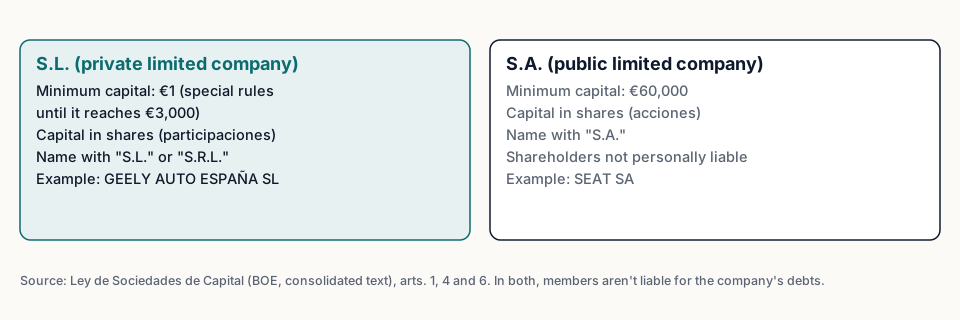
Minimum capital (article 4). An S.L.'s capital can't be less than one euro. Until it reaches €3,000, the law adds two rules: at least 20% of profit must go to the legal reserve until reserve and capital together reach €3,000, and, if the company is wound up without enough assets, the members are jointly liable for the difference between €3,000 and the subscribed capital. An S.A.'s capital can't be less than €60,000.
Kinds of shares (article 1). An S.L.'s capital is divided into participaciones sociales; an S.A.'s into acciones.
The form says nothing about the size of a particular company: there are S.L.s with large capital, such as GEELY AUTO ESPAÑA SL (€373,000 according to the BORME), and S.A.s of very different sizes.
How to recognise the form in a name
Article 6 requires the form to appear in the company name:
- An S.L. must carry "Sociedad de Responsabilidad Limitada", "Sociedad Limitada" or the abbreviations "S.R.L." or "S.L.".
- An S.A. must carry "Sociedad Anónima" or the abbreviation "S.A.".
So in the BORME you can read the form in the name itself: QILOVATIO ENERGIA IBERIA S.L., SEAT SA, IBERDROLA SOCIEDAD ANONIMA.
Single-member companies
An S.L. or an S.A. can have a single member. Under article 13, the incorporation of a single-member company, a declaration that a company has become single-member, the loss of that status or a change of the single member are recorded in a public deed registered in the commercial registry. While it lasts, the company must state that it's a single-member company in its documents and correspondence, which is why you'll often see the letters S.L.U. or S.A.U.
In the BORME it shows up as an act: declaración de unipersonalidad (declared single-member), pérdida de la unipersonalidad (status lost) or cambio de socio único (single member changed). Real example: GEELY AUTO ESPAÑA SL declared itself single-member at its incorporation (BORME-A-2025-248-28).
What the BORME publishes for each
The act types are the same for both forms: incorporation, officers, changes of registered office or bylaws, capital, mergers, dissolution, extinction. Some real examples:
- S.L.: the incorporation of GEELY AUTO ESPAÑA SL (BORME-A-2025-248-28), its capital increase (BORME-A-2026-72-28), the extinction of QILOVATIO ENERGIA IBERIA S.L. (BORME-A-2026-97-08).
- S.A.: SEAT SA's merger by absorption (BORME-A-2026-96-08), AENA S.M.E. SA's appointments (BORME-A-2026-38-28).
For what each act means, read how to read the BORME.
In Fuentio's data, the form is read from the name's mandatory suffix and given with its original label and its ISO 20275 code (ELF): DP3Q for the S.L., 5RDO for the S.A. That code makes it possible to compare with forms in other countries; for France, read French company legal forms explained.
Why it matters when you check a company
- Consistency with documents. A contract in the name of "X, S.A." when the registry shows an S.L. deserves a question.
- Capital. The BORME publishes capital when an act states it; it's a registered figure, not a measure of solvency.
- Changes of form. A transformation (from S.L. to S.A., for example) is published as an act; today's form may not be the one of a few years ago.
- Single-member status. A company with a single member has that fact recorded in the registry; the act that declared it is in the BORME.
If you work with companies in both countries, the comparison is easy to get wrong: the French SARL resembles the Spanish S.L., but the rules on capital and members differ, and each country's register publishes different things. Read each company in its own register's terms. For checks on Spanish companies, keep the registry sheet and province with your record: they identify the company in the BORME more reliably than its name, which can change. See what we cover in France and Spain.
Limits. This guide summarises articles of the Capital Companies Act (BOE, read on 8 October 2026); it doesn't replace a company's bylaws or advice on choosing a form. The capital published in the BORME says nothing about solvency. Fuentio can't look companies up by NIF or CIF. Not legal advice.
Frequently asked questions
What's the minimum capital of an S.L.?
One euro, under article 4 of the Capital Companies Act, with special rules until it reaches €3,000.
And of an S.A.?
Sixty thousand euros.
What do S.L.U. and S.A.U. mean?
That the company has a single member. The law requires it to say so in its documents while that's the case.
Are members liable for the company's debts?
In an S.L. and an S.A., members aren't personally liable for the company's debts under article 1 (with article 4's special rule for an S.L. with less than €3,000 of capital that's wound up).
Sources
- Ley de Sociedades de Capital, consolidated text (read on 8 October 2026): boe.es
- Law 18/2022 (amendment to article 4): boe.es
- The BORME on the BOE: boe.es/diario_borme