"Send us a Kbis less than three months old": the request is familiar to anyone who works with French companies. But the Kbis is no longer the only document that proves a French company exists, and not always the most suitable. There is also the status notice from INSEE's Sirene directory, and the proof of registration in the national register of companies (RNE). This guide explains where each comes from, what it costs, when it's accepted, and where register data fits.
The prices and duties below come from service-public (the French administration's official information site), urssaf.fr and insee.fr, read on 8 October 2026. Always check the official page.
What you'll learn
- Where the Kbis, the Sirene status notice and the RNE proof come from
- What each costs and how to get it
- When each is accepted, including for the duty of vigilance
- Why the French administration no longer asks for a Kbis
- Where register data fits, and its limits
The three documents, side by side
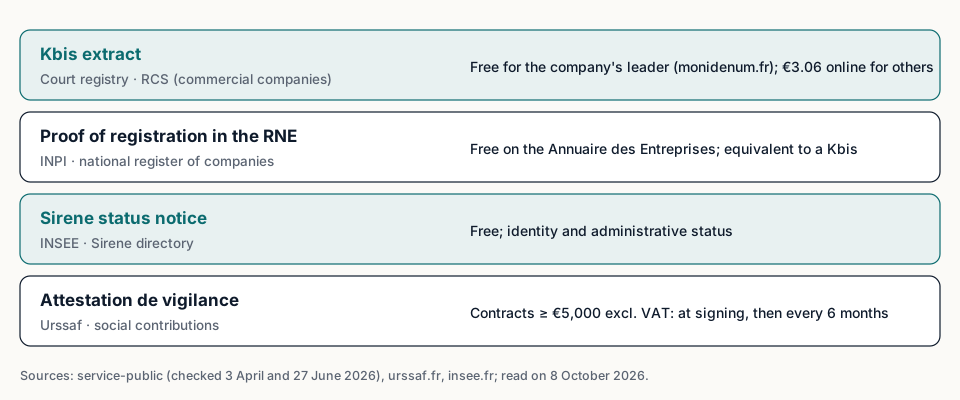
The Kbis extract proves that a commercial company is registered in the trade and companies register (RCS). It's issued by the commercial courts' registries. For a sole trader, it's called an extrait K. According to service-public (page checked on 3 April 2026), a company's leader can get their own company's Kbis for free on monidenum.fr. Another company's Kbis is ordered from the Infogreffe website: €3.06 delivered electronically, €4 by post, or €2.44 in person at the registry. In most cases, the extract requested must be less than three months old.
The proof of registration in the RNE proves registration in the national register of companies, kept by INPI. Service-public describes it as an equivalent of the extrait K or Kbis, downloadable for free on the Annuaire des Entreprises, the State's public company directory.
The status notice from the Sirene directory (avis de situation) is issued by INSEE from a SIREN or SIRET. It shows the identity of the company or establishment in Sirene, including its administrative status. The service is free (service-public, page checked on 13 January 2025).
The administration no longer asks for a Kbis
Service-public says it plainly: the extrait K or Kbis is no longer requested by the administration for formalities. Instead, the SIREN number or the proof of registration in the RNE can be provided. Service-public gives the example of applying for a public contract.
So for your own dealings with the French administration, there's no need to pay for a Kbis. Between businesses, on the other hand, a customer, a bank or a landlord may still ask for one. You can offer the free RNE proof instead.
The duty of vigilance: which documents?
When you use a subcontractor in France, the law gives you a duty of vigilance as part of the fight against undeclared work. According to service-public (page "Recourir à la sous-traitance", checked on 27 June 2026), the contracting company must ask, when the contract is concluded and then every six months until it ends, for:
- the Urssaf attestation de vigilance, for any contract of at least €5,000: it proves the subcontractor is up to date with its social contribution declarations and payments;
- a document proving registration, when registration in the RCS or the RNE is mandatory: an extrait K or Kbis, a proof of registration in the RNE, a quote, advertising document or business letter showing the name, full address and registration number, or the electronic acknowledgement from the court registry or the chamber of trades.
Urssaf adds that the €5,000 threshold is excluding VAT, on the total amount of the service even if it's paid in several instalments, and that the contracting company must check the attestation's authenticity by entering its security code on urssaf.fr. If the contracting company fails in this duty and the subcontractor is convicted of undeclared work, it can be held jointly liable for various sums.
In other words, the free RNE proof is enough on the registration side: the paid Kbis is just one of the options.
Where register data fits
All three documents are snapshots: they say what was true on the day they were produced. A two-month-old Kbis doesn't tell you the company hasn't ceased since.
Register data, read at the moment you need it, complements these documents:
- Before asking for a document, check that the SIREN exists and the company is active. It saves exchanging paperwork with a company that has ceased.
- When a document arrives, compare the name, SIREN and address with the official data. A difference deserves a question.
- Between two due dates, a quick status check tells you whether anything has changed.
The same approach works for any supplier, not just subcontractors under the duty of vigilance. A short routine (check the number, check the status, compare the document, keep the date) takes a few minutes per supplier and gives you a record you can show later.
To read a company's status, see how to check whether a French company is still active; for how the registers work, see the French company registers explained.
See what we cover in France and Spain.
Limits. The prices, timings and duties cited come from service-public, urssaf.fr and insee.fr, read on 8 October 2026; they can change. Register data confirms a company's existence and status; it doesn't replace Urssaf's attestation de vigilance and says nothing about social contributions. Not legal advice.
Frequently asked questions
Is the Kbis free?
For the company's own leader, yes, on monidenum.fr. For another company, it costs €3.06 online, €4 by post or €2.44 at the registry, according to service-public.
Does the RNE proof replace the Kbis?
Service-public describes it as an equivalent of the extrait K or Kbis, downloadable for free, and the administration accepts it instead of a Kbis. Between businesses, it's up to the other party to accept it.
How long is a Kbis valid?
Service-public says that, in most cases, the Kbis extract requested must be less than three months old.
Does the Sirene status notice prove registration?
It shows the company's identity and status in INSEE's Sirene directory. To prove registration in the register, service-public cites the Kbis and the RNE proof.
Sources
- Service-public, "Comment obtenir un extrait K ou Kbis ?" (checked 3 April 2026, read on 8 October 2026): entreprendre.service-public.gouv.fr
- Service-public, "Recourir à la sous-traitance" (checked 27 June 2026, read on 8 October 2026): entreprendre.service-public.gouv.fr
- Urssaf, "Obtenir et vérifier une attestation de vigilance" (read on 8 October 2026): urssaf.fr
- Service-public, Sirene status notice (checked 13 January 2025): entreprendre.service-public.gouv.fr
- Annuaire des Entreprises: annuaire-entreprises.data.gouv.fr