Company verification is usually discussed as a compliance task: KYB, onboarding, anti-money-laundering reviews. Those matter, and we cover them in what KYB is. But the same simple check (does this company exist under this number, what is its legal name, is it active, where is it registered) is useful in many places that have nothing to do with compliance. Here are five, with what to check in each and what not to expect.
What you'll learn
- Five places where a register check helps, outside KYB
- What to check in each, and when
- What each check can't tell you
- How to keep the checks traceable
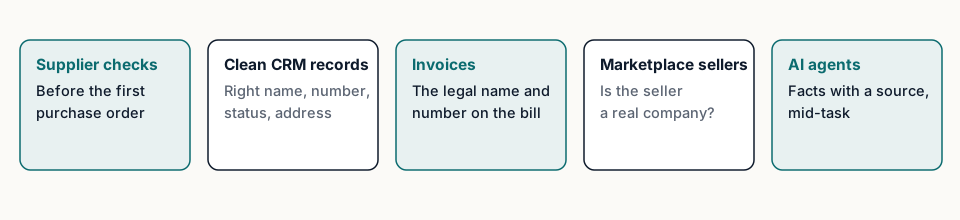
1. Checking a new supplier before the first order
Before you pay a new supplier, procurement teams usually want to know that the company exists, that it's active, and that the name and number on its quote are its own. A register check answers those three in one go.
What to check: the legal name, the official number, the status and the registered address. Compare them with what the supplier sent you.
When: before the first purchase order, and again before large or unusual payments.
What it won't tell you: whether the supplier will deliver, whether its prices are fair, or anything about its finances. It tells you the company you're paying is the company you think it is.
2. Keeping CRM records clean
Customer databases drift. A company renames itself, moves, or closes, and the CRM keeps the old details for years. Sales and support then write to closed companies, invoice the wrong name, or merge two companies with similar names.
What to check: look each account up by its official number, and update the legal name, status and address from the register's answer. Flag the accounts whose status is ceased, in liquidation or closed.
When: when an account is created, then on a schedule that suits your volume.
What it won't tell you: who your contact is now, or whether the company still buys from you. The register knows the company, not the relationship.
The key habit here is storing the official number with every account. A name is a label; a SIREN, a registry sheet or a SIRET is an identity. If you work with French companies, French company registers explained shows which number to ask for.
3. Getting invoices right
An invoice to a business usually needs the customer's legal name and, in many countries, its registration or VAT number. Getting them wrong can mean a rejected invoice, a delayed payment, or a correction later.
What to check: the exact legal name as registered, the official number, and, for France, the VAT number when the source gives it. Renault, for example, has the SIREN 441639465 and the VAT number FR63441639465 in the official French data.
When: when a new business customer is set up for billing, and when they tell you they've changed name or address.
What it won't tell you: what your own country's invoicing rules require. Check those with your accountant.
4. Checking marketplace sellers
Marketplaces that accept business sellers want to know the seller is a real, active company, and that the company name shown to buyers is its legal name or a name it's entitled to use.
What to check: that the company exists under the number the seller gave, its legal name, its status, and the roles of the officers the register lists, compared with the person who signed up.
When: at sign-up, and again when a seller changes its company details.
What it won't tell you: whether the seller's products are genuine or its reviews honest. A register check confirms the company; your other checks cover the rest. It supports fewer manual checks; it doesn't make the decision to accept a seller.
5. Giving AI agents facts with a source
Agents that work with businesses (sales assistants, procurement agents, back-office agents) are asked about companies all the time. Answering from the model's memory gives confident, unsourced and sometimes outdated answers. Calling a register-backed tool gives an answer with its source and date.
What to check: the same facts as above, through a tool the agent calls, with the source passed back to the user.
When: every time the agent needs a company fact, rather than relying on what it remembers.
What it won't tell you: anything the register doesn't record; and if a company is outside the tool's sources, the agent should say so. See how AI startups can give their agents reliable company data.
What do the five have in common?
Each one starts from an official number, asks the official register, and keeps the answer with its source. Not one of them needs a judgement from the register; they need the register's facts, stated plainly, with a date. That's also why the same lookup serves all five: the difference is only when you run it and what you do with the answer. A procurement team acts on a closed supplier, a CRM flags it, an invoice uses its legal name, a marketplace pauses a seller, an agent tells a user. The check is the same.
How do you keep all these checks traceable?
Whatever the use, store four things with each check: the official number you looked up, the source and its link, the date you checked, and the register's own words for the status. That makes each check easy to repeat and easy to explain, months later, to whoever asks.
Where does Fuentio fit?
Fuentio answers these checks from official registers in France and Spain. Every answer carries its source, licence and check date; companies outside our coverage get "not covered by an automated source" and the official register's link. See what we cover.
Limits. A register check confirms the facts a register records: existence, name, number, status, address, officers' roles. It says nothing about a company's finances, reliability or reputation. Fuentio covers France and Spain; in Spain it holds companies with a BORME act since 6 October 2025 and can't look companies up by NIF, CIF or VAT number.
Frequently asked questions
Do I need an API for these, or can I check by hand?
For a few companies a month, by hand is fine. Once checks repeat, or happen inside your software or an agent, an API does them the same way every time and keeps the source.
How often should I re-check?
It depends on the use: at creation for invoices, on a schedule for CRM clean-up, before payments for suppliers.
What if a company isn't found?
Check the identifier first. If it's right and the company is outside the source's coverage, check the official register of its country by hand.
Does a register check tell me whether a company will pay?
No. It confirms who the company is, not how it behaves.
Sources
- Fuentio's coverage: coverage page
- INSEE, definition of the SIREN number: insee.fr
- Fuentio's sources and their licences: sources page